Quilt Gallery

Thursday, September 10, 2020

Climbing Mt. Moran in Grand Teton National Park

When most people think of Grand Teton National Park, they naturally think of the Grand Teton, the mountain which gives the parks its name and the range's tallest mountain. Frequent readers may remember that I climbed the Grand in 2018. Late last month I climbed another of the range's prominent peaks, Mt. Moran. 


Moran stands out on the northern end of the range, easily visible from Leigh and Jackson Lakes, the Jackson Lake Lodge, and the park road. Distinctive for its sheer massiveness, flattish top, and enormous, dark, nearly vertical dike jutting out from its eastern side. It is aptly named after Thomas Moran, the landscape artist who painted many dramatic and influential scenes of the American west.

Moran presents some very different challenges to the climber than does the Grand Teton, beginning with a canoe trip across String and Leigh Lakes to reach the approach climb up the stream flowing out of Falling Ice Glacier.


Then begins an unrelentingly steep two mile (and 2700 vertical feet) hike to camp. For most of the hike, you can see the West Horn and the East Horn on either side of the glacier, displaying the classic U shape profile of glacially carved valleys.


Eventually you bear off to the left onto a glacial moraine where the camp is located. Judging from the rock walls build around obvious tents sites, high winds are common in this area. Here's a view looking out of our tent door at the wall.


After an early dinner and arranging gear for a pre-dawn start I snuggled into my sleeping bag. And mostly didn't sleep because I was just too nervous thinking of the day ahead. It was a relief when it was finally time to get up and get going, headlamps lighting our way. 

It turns out we were in for a long day - nearly 12 hours from camp to the top and back down to camp, which is pretty typical for this climb - and another factor differentiating it from the Grand. Our aim was to follow the Chicago Mountaineering Club (CMC) route so we scrambled and climbed our way to the top of Drizzlepuss, a tower between the West Horn and the east face of Moran, then rappelled down to reach the east face which we then climbed in multiple pitches to reach the summit. For scale, you can see two climbers on the east face (in the middle of the lefthand side of the photo).


Throughout the day we moved slowly but steadily, thanks to our expert guide, Jed Porter, of Exum Mountain Guides. He knows the route in detail, pitch by pitch, which allowed us to avoid any route-finding delays, and he worked efficiently to set up the ropes to keep us safe. Since we climbed and rappelled one at a time I had a few opportunities to snap photos of the incredible scenery. This one is a view of the Falling Ice Glacier wedged between the East Horn and the West Horn. On the right hand side you can see Leigh Lake which we had paddled across the previous day.


Here is a close-up view of the dike. I have heard it called the "black dike," but it is really reddish brown. Regardless of its color, at 125 feet thick it is enormous!


And here we are at the top (with the Grand in the background) masks and all. Yes, we really did wear masks for much of the climb - any time we were close together, or about to be close together such as during belays and rappels. That's me on the left and if you're wondering why my shirt looks so lumpy, it's because my rappel gloves are stuffed inside.


For further proof that we reached the summit, here is my photo of the USGS summit bench mark. 12,605 feet above sea level, though the number is not engraved on the benchmark.


Here's one more view of the top, which, except for the dike, is comprised of Cambrian Flathead Sandstone, apparently none of it actually in place. Some blocks are in a random jumble, others form a patterned ground - geometrical shapes likely made by frost heaves.


After summit photos and a quick snack we turned back to camp, reversing our steps from the route up. This time though we rappelled down parts of the east face. Here is Jed setting up the ropes to rappel,


and here he is on the way down. Once again the views were stunning!


Then we reclimbed Drizzlepuss, which presented the trickiest maneuvers of the day, and which we fortunately handled without trouble. From there it was a scramble back to camp for a well-earned and delicious dinner of instant mashed potatoes and smoked oysters. Exhausted and exhilarated, we were back in our tents before sunset, though peeked out to see the high peaks glowing in the late evening light.
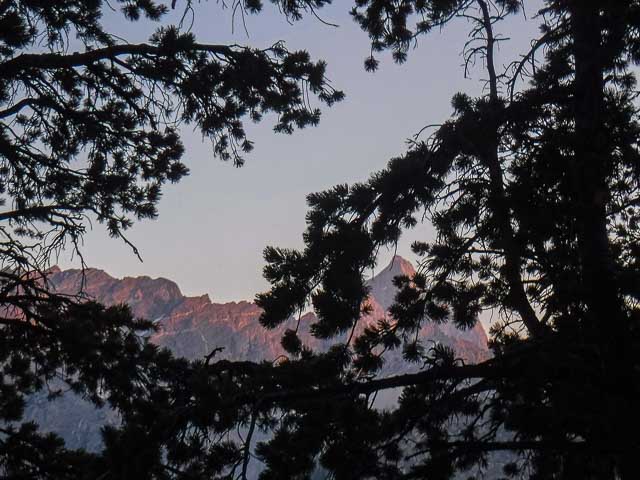

Though Moran may not be as famous as the Grand, it is a worthy climb in a stunning location. It offers more actual climbing than the Grand, though generally with less exposure. Spending two nights camping, rather than one in a hut, also gives you more time to enjoy the relative solitude of the back country.


Friday, July 31, 2020

Bits and Pieces


Last month I complained about all the scraps generated by following Kaffe Fasset's directions for his Facet quilt. I also mentioned that I had a project that would use up most of those bits and pieces and here it is: another quilt top made of triangles. I cut the triangles with a die-cutting machine, so that part at least went very quickly.


I used scraps to make the multi-colored rows, offsetting the triangles to make the zig zag pattern.


I ran out of the solid blue I was using to separate the colored rows, and not wanting to venture out to buy more, improvised with other fabrics that I had on hand. 


That was probably a mistake. The blue is nice and crisp and I think the other colors muddy things up. I'm not going to undo it though since I expect it will look a little better once it is quilted and bound. And it will still keep whoever sleeps under it warm.

Thursday, July 23, 2020

Hiking in the Hill Country: Grelle Recreation Area

After staying at home for many weeks due to the coronavirus pandemic, we decided to explore a bit of the hill country and visited the Lower Colorado River Authority's Grelle Recreation Area


The park encompasses 276 acres on the south side of Lake Travis on the eastern end of Burnet County, a 45 minute drive from downtown Austin and a 20 minute drive from Marble Falls.

We arrived early on a Monday morning, used the honesty box for our entry credentials, and parked in a small but empty lot near the camping and picnic areas. With no one else around we didn't have to worry about social distancing.


At the trailhead we picked up a free map and off we went, winding through stands of ashe juniper,


live oaks and cedar elms.


The trails are well signed, though we chuckled about the possibly Freudian bit of confusion over the name of one of them. Is it "Bridal Pass?" 


or "Bridle Pass?" 


As you would expect, Overlook Trail offers fine panoramic views.


The open fields were lovely too, with lemon mint flowers standing out amid the green and gold grasses.


Grelle is also a nice spot for swimming, kayaking, and horseback riding. 


Now that it is full on summer here and temperatures reach the high nineties and 100s every afternoon, I would highly recommend a morning excursion.

Tuesday, June 30, 2020

Small Towns of Croatia's Dalmation Coast

This is a long overdue post and in the months since I visited Croatia the world has changed in previously unimaginable ways. But now that most of us can only travel virtually from our armchairs these days, I thought I'd go ahead and post something more about Croatia, a popular bucket list destination.

As I mentioned several months ago, last October my family and I took a weeklong cruise from Split to Dubrovnik and back, stopping to explore several of Croatia's scenic small towns along the way. Our first morning found us in Bol on the island of Brač.


We spent a delightful few hours strolling from the harbor in the main part of town to the Dominican monastery and back, with views of the Adriatic the entire way. This little chapel was particularly charming.


Our next stop was Hvar, on the island of Hvar. Here it is seen from the water, with the early 16th century Spanish fortress on the skyline.
 

As in all the towns we visited, nearly everything is made from local stone: churches, residences and shops, and even pavers in the town squares and the smallest alleyways.


At every stop we walked and walked, and climbed flight after flight of steps.


In Hvar you can climb all the way to the fortress (though we took a cab) to take in the views.


Hvar town, spread out below us, glowed in the late afternoon.


Another day found us on Korčula, a gem of a town with a long and complicated history, having been under the control of Greeks, Venetians, and French, among others. If our guide is to be believed, the central old town is largely unoccupied now, and the buildings have been turned into restaurants, shops and hotels catering to visitors. Still, it is worth wandering around the narrow streets and alleys. 


It is also worth climbing the bell tower of St. Mark's Cathedral to see the town's red-roofed buildings spread out below.


Dubrovnik, the best known town on the coast, has largely recovered from damage in 1991-1992 during the Croation War of Independence and now hosts thousands of cruise ship passengers every day. Sadly, I found it overcrowded and missing the lazy charm that I found so appealing on my first visit in 1989. Still, it is a beautiful city. The afternoon sun bathes the old stone in yellow light, making it look like it has been carved from butter.


Grand architectural details abound.


At every turn you can find picturesque scenes, from the harbor


to the vibrant streets and closely packed buildings.


Amid all the hustle and bustle we managed to find a place of quiet refuge, the Franciscan Pharmacy in the old monastery. It is apparently the third oldest operating pharmacy in Europe. You can tour the museum, sit in the lovely central garden, and even purchase skin care and other products from the pharmacy.
 

Our next stop, Mljet National Park, was, thankfully, far quieter. I spent the first part of the afternoon running the 10 kilometer trail around Great Lake, a salt lake with clear blue water and a couple of tiny villages along the way.


Then, I hopped on the little boat for a ride to the isle of St. Mary's to visit the Benedictine monastery.


Our last island visit was to the village of Pučišća, on the island of Brač. Next to Korčula, I thought it the prettiest of our stops, with modestly sized white stone buildings, capped with red tile roofs, stepping up the hillsides. In this village even benches and light poles are made from local stone. 


Which is no wonder, since it is adjacent to a large quarry and home to Croatia's only stonemason school. We were given a nice tour of the school by one of its current students.


Our final stop before returning to Split was the town of Omiš, about ten miles east of Split.  Massive, steep cliffs loom up over the town.


We spent the morning motoring up the Centia River gorge in a small boat, passing fishermen and their little huts.


The area offers many opportunities for recreation, including zip lining across the gorge.


Our destination was Radman's Mills, a several-hundred year old mill site now operated as a restaurant and picnic area. We had a nice snack of local cheese, meat, and fresh bread before heading back to Omiš.


Back in Omiš I spent a little more time appreciating the details: a colorful waterfront, 


an elegant public water faucet,


and aging, but still sturdy and elegant buildings.


And here is a photo of the clear Adriatic water, which beckoned some of us to swim every day.


I will end with this quilt top as I did some of the hand piecing while on this trip. It was inspired by Denyse Schmidt's Free-Wheeling Single Girl Sew-Along. Mine is rather wonky because I didn't manage to get the official templates and used hand-drawn paper ones instead. I have to admit that I got a little bored working on it, probably because the colors are fairly muted, but I think it turned out pretty well. More importantly, I think it will always make me think of Croatia. Besides working on it there, the blues remind me of the Adriatic and the yellows remind me of Croatia's stone buildings glowing in afternoon sunlight. 


Sunday, June 14, 2020

More Covid Quilting - Kaffe Fassett's Facet Quilt

I finished up another quilt top a couple weeks ago. In a first for me, not counting quilt alongs, I followed a published pattern, the Facet quilt by Kaffe Fassett and Liza Prior Lucy from their book "Simple Shapes, Spectacular Quilts."


My original plan was to use up a good part of several jelly rolls that have been sitting in my stash for too long. Since this pattern called for strips it seemed like a good idea. But when I looked at those fabrics together, I realized they didn't have enough visual interest: the patterns were too small and were too monochromatic to work properly. I found myself pulling more and more other fabrics from my stash, including several Kaffe Fassett prints and a bunch of fun Tula Pink fabrics.


As I was making it I wasn't sure I if I'd be pleased with the result, but I'm glad I soldiered on to finish it. The colors are fresh and the design is crisp.


I did manage to use up some of the jelly roll fabrics, most of which ended up in the border.


I should note a couple of quibbles I have with the pattern as written. First, it instructs you to cut all the strips to at least 11 inches long. Once the strips are sewn into rectangles they get trimmed down to 8 5/8 inches, leaving a nearly 2 1/2 inch wide scrap, which seems excessively wasteful. Fortunately, I happen to have a scrap quilt in progress that accommodated most of those pieces. 

Second, the instructions tell you to use a quarter inch seam throughout. That is incorrect because of the tall triangles. The correct way is to sew the triangles into rectangles with a quarter inch seam, then sew the rectangles into horizontal strips with quarter inch seams. Finally, sew the horizontal strips together with a nearly half inch seam. You can measure the edges where the points come together to get the exact seam allowance.

Since we aren't traveling, I'll leave you with a couple images of our resident fox, out early one morning in search of a meal for her three kits. 


She is remarkably nimble - we watched her climb straight up this very steep cliff.