Quilt Gallery

Thursday, February 27, 2020

Croatia's Dalmation Coast

Croatia is a tiny country, smaller than West Virginia, but it packs a lot worth seeing into that small space. Dalmatia, the southernmost region of Croatia, strung out along the Adriatic coast, encompasses about a quarter of the country's area and includes 79 little islands. It is packed with lovely and historic towns, stunning scenery, kind people, and many delightful restaurants and cafes.

The best way to see the islands and visit the smaller towns is to book a tour on small boat. Last fall, along with my family, I went on a seven day excursion from Split to Dubrovnik and back, with lots of stops in between, aboard a 38 passenger boat, the M/S Desire. This post focuses on Split, the second largest city in Croatia. I'll follow up with another post or two on the other towns.

Split's main attraction is Diocletian's Palace which was built for the Roman Emperor, Diocletian, in the 4th century as a place for him to retire. Here is a view of the peristyle, or central courtyard, the heart of the palace.


Original construction of the palace included twelve sphinxes from Egypt. This one is the best preserved of the remaining three.


Wander through the palace and you can spot other original decorative elements, such as this mosaic floor,
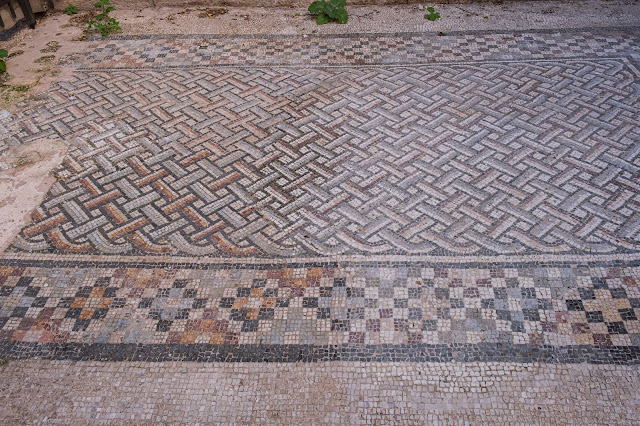

and the round vestibule, or waiting room.


Today you can see the sky through what was once a domed roof.


It is fascinating to explore the narrow alleys,


the impressive basement (which now houses vendors of local wares),


and open courtyards.


Today the palace is a fascinating patchwork of private residences,


shops, hotels, and restaurants.


Speaking of patchwork, here are a few images of patchwork that I have been stitching away at recently.  I worked on a few pieces for Denyse Schmidt's Free-Wheeling Single Girl quilt-along during this trip, using fabrics from my visit to Phoenix. I will need nine of these to make up an entire quilt so I am clearly way behind on but it's fun to work on here and there.


And here is a top that I finished almost a year ago, using up some blue scraps. I've finally picked out a backing for it, so maybe I'll have a finished quilt soon.


Monday, December 23, 2019

Phoenix, Arizona

Back in the days when I worked for Motorola's semiconductor business, I made a number of trips to Phoenix. And in all that time never saw anything other than the inside of the airport, air-conditioned cars, and air-conditioned offices. This time I was lucky enough to have a few days to explore, along with unseasonably wet and cool weather to make it comfortable. We started with an alfresco lunch at the Phoenix Biltmore, after which we strolled in the gardens and through the public areas of the hotel.


Opened in 1929, it was designed by Albert Chase McArthur, a student of Frank Lloyd Wright. The blocks and other elements of which the hotel is constructed all have a geometric design that struck me as something that would lend itself to quilt blocks.


Interestingly, the blocks are called "textile blocks" because of how they are held together with lengths of rebar in two directions, like the warp and weft of a woven fabric.

After a day spent attending meetings and lectures indoors, Steve was eager to get outdoors, so we set an early alarm and drove to Phoenix Mountain Preserve, arriving at the trailhead to Piestewa Peak before dawn. Lingering clouds from the previous night's rainstorm made for interesting views. 


The trail is short but steep, gaining more than 1,000 feet in just over a mile, but it is well marked and in most places the footing is good due to carefully built stone steps.


Still, it is rated as "extremely difficult." I suspect the Phoenix climate may contribute to that. The weather was comfortable for our hike, but Phoenix summers would make for a brutal outing.


Having started before sunrise, by the time we finished our hike, and found some coffee and breakfast, we still had most of the day ahead of us. Next stop was the Desert Botanical Garden, 140 acres dedicated to preserving and showcasing an enormous variety of desert plants.


I liked the playfulness of these Chihuly glass sculptures at the entrance.


It is truly a wonderland of texture,


color,


and shape.


I highly recommend a visit, though definitely go early if the day promises to be warm. In addition to wandering paths through several themed areas (Sonoran Desert, wild flowers, etc.), you can have a drink or lunch at the cafe, browse the shop, and participate in special events.

Our final stop was completely serendipitous. We happened to see a sign for it, and being curious about fire fighting because our daughter has worked the past three summers as a wildland firefighter, decided to make a visit.


It is quite an amazing place, filled with thousands of fire-related items spanning several centuries. As you might expect, there is a lot of red and gold. Firefighters have clearly taken great pride in their equipment for a very long time!


In addition to these older pieces, there is a tribute to 9/11 first-responders and videos of current practices in wildland firefighting.

Naturally I also had to visit a local quilt shop, so I chose Modern Quilting. I picked up a few pieces of fabric, with the intention of participating in Denyse Schmidt's Free-Wheeling Single Girl sew-along.


I guess most participants are finished by now and I haven't completed even one square yet, though I do have a few pieces started. I've been doing this by hand, and without Denyse's templates so it will be interesting to see how it turns out.


Wednesday, October 9, 2019

Not So Hard Travelin' on The Lincoln Highway

Needing to drive from Jackson Hole to Austin at the end of this summer, we gave ourselves enough time to take back roads and to stop at some sights along the way.

Barely beyond the valley that is Jackson Hole, we stopped in Dubois so that I could nip into Wyoming Wool Works, a gem of a shop housed in the old Masons building, just behind The Opportunity Shop. Actually there are several shops in the building, but my favorite is Anita Thatcher's, which always has interesting local yarns and knits. Anita has a terrific eye and this time was selling trimmings from Pendleton blankets. I picked up this roll from the Glacier National Park blanket, one of their earliest patterns.


I've already used most of it up for this crocheted cat bed.


I like how it turned out but Sarah is still trying to decide if it suits her.


Back on the road we drove southeast to Independence Rock, so called because pioneers along the Oregon Trail hoped to arrive here by Independence Day, ensuring they would have enough time left to cross the Rockies before winter snows arrived.


From there we pushed on towards Laramie for the night, across miles and miles of open plains, seemingly empty except for wind turbines.


In Laramie we hopped onto I - 80 and headed east, but quickly tired of the heavy traffic and 18-wheelers and looked for an alternate route. And there, a mile or so to the north and running parallel to I-80, was US 30. Dedicated in 1913 and also known as the Lincoln Highway, US 30 was the first auto road to cross the continent, running between Lincoln Park in San Francisco and Times Square in New York.


Perhaps you are familiar with it from Wo0dy Guthrie's song Hard Travelin':

"And I've been hittin' some hard travelin', Lord
I've been walking that Lincoln highway, I thought you knowed,"

We drove most of the way across Nebraska along the Lincoln Highway, but fortunately it was not a bit hard for us in our comfortable, modern vehicle. Though I could imagine how hard and brown it might have been like back in the depression and dust bowl years, I found it quite beautiful, as much for the dense rows of nearly ripe corn marching across the undulating hills as for the sense of freedom that comes with seeing a wide open road stretching all the way to the horizon.


We did stop in several of the many towns along the way. They are spaced about ten miles apart along this section of the Lincoln Highway, and if our tour guide in the capitol in Lincoln was correct, it is because they were established along the rail line to service trains, which needed fuel and water every ten miles. They are all pretty quiet these days, but have a certain charm that elicits feelings of nostalgia for simpler days. 


Every town has its grain elevator, each unique in design, but all standing testament to a shared agrarian history.


In Gothenburg we stopped at this cabin which was once used as a Pony Express station. Sadly it is not open for visitors and information about it is limited to the plaques on the front.


Beyond exploring new places, road trips appeal to me for the quiet time I get when I'm in the passenger seat. I finished this pair of knee socks. And now that the weather is getting cooler in Austin, I may even have a chance to wear them soon. Just not for hard walking on the Lincoln Highway.