Quilt Gallery

Showing posts with label Knitting Knee-Highs. Show all posts

Monday, August 19, 2019

A Day's Jaunt in the Texas Hill Country

In the middle of August when central Texas temperatures reach well into the 100s, it is nice to look back on May's 80 degree days. Having been to San Antonio for an evening event and overnight stay, rather than brave I-35, we took the long and scenic route home to Austin. Our first stop was the General Store in Bandera where we picked up coffee, since it was too early for ice cream.


Just across the street I spotted Lavender and Sage Stitchery, the first yarn and needlework shop I've ever encountered with a saddle on the rail out front.


Naturally I had to go in for a look. And found this hand dyed yarn by Savvy Skeins, a Texas company.


The color, called "Boyfriend Jeans" contrasts nicely with a leftover from my stash, TeenyButton Studio's hand-dyed "Patisserie Party." And so I have been knitting these socks using the Flora Knee High pattern from Barb Brown's book, "Knitting Knee-Highs." This is the second sock, so I should be finished by the time cooler weather sets in.


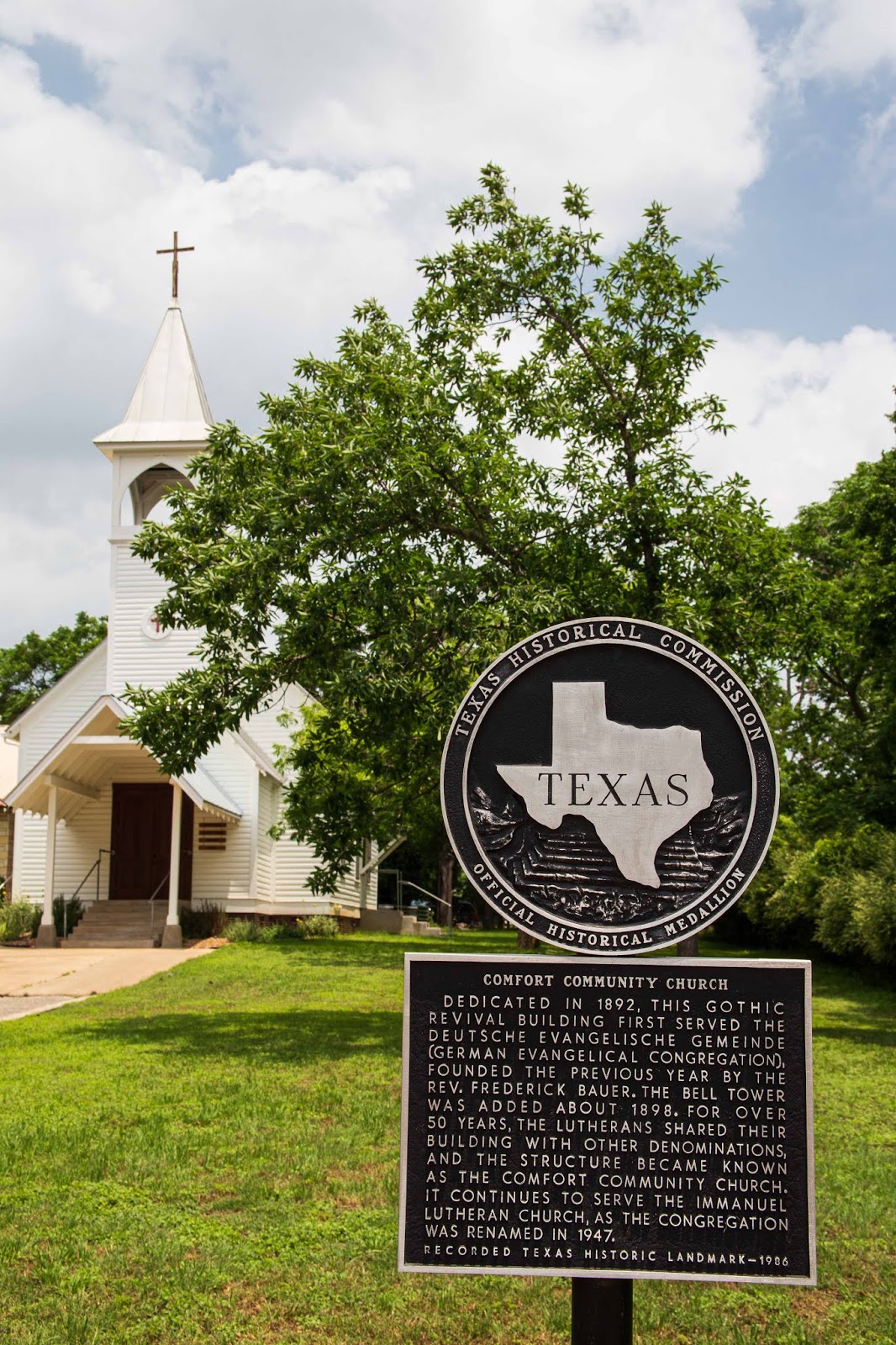
But back to our little jaunt. Next stop was Comfort where we saw the tiny Gothic revival Comfort Community Church,


as well as the 1866 Treue Der Union monument, memorializing 68 men who remained loyal to the Union during the Civil War.


The monument is fittingly located at the edge of a lovely park graced with beautiful live oak trees including this giant.

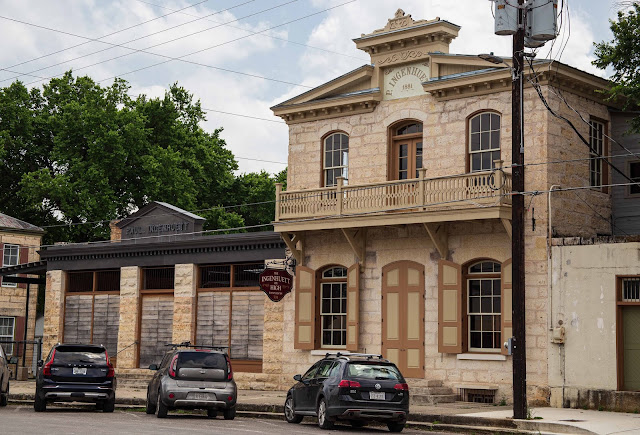
In the main part of town, we strolled along Main Street, which has a couple blocks worth of interesting old limestone structures.


I found Comfort's history as a center for Freethinkers fascinating.


Ready for lunch, we stopped at High's Cafe & Store, where we had a deliciously fresh meal. It's definitely on my list of places to visit again.


Our last stop was Old Tunnel State Park. The tunnel, used by the Fredericksburg and Northern Railway until 1942, is now home to millions of Mexican free-tailed bats and became a state park in 2012. Since we were there during the day we didn't get to see the bats emerging, so this is another place we'll have to visit again.

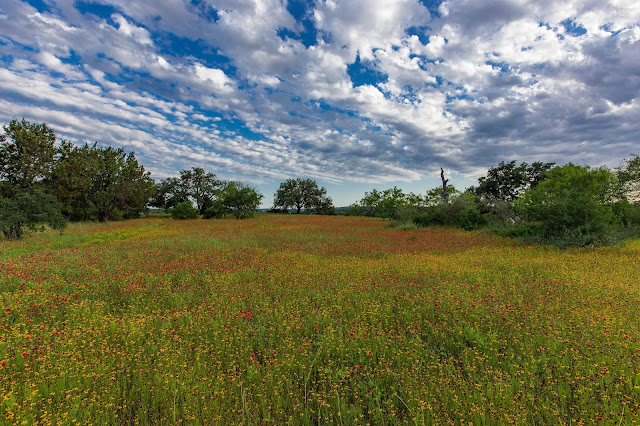
The other nice thing about a drive in central Texas in springtime is, of course, the amazing wildflowers. Here's a shot from Travis County to give you an idea of just how spectacular it can be.


Sunday, June 1, 2014

Message on a Bridge: Make Art

Several weeks ago we were in Northfield, Massachusetts, to attend Sacred Concert at Northfield Mount Hermon School. As the girls' days were filled with with concert rehearsals and end-of-term school work, we were left on our own. We used the time to explore Northfield and the lovely Schell Bridge on the north end of town.

Northfield is a classic New England town, its wide main street lined with clapboard buildings, spired churches, and big trees. It is perhaps best known as the birthplace of the nineteenth century evangelist Dwight L. Moody. In addition to founding Northfield School for girls on a hill adjacent to his birthplace, and later the Mount Hermon School across the river in Gill, he attracted people from around the country and the world to Northfield.

One of these people was Francis Schell of New York who built an expansive chateau near the Northfield School. Schell found the town's most unusual physical feature  -- it straddles the Connecticut River, with Main Street on the east side and the train station on the west side -- highly inconvenient. So in 1903 he donated a bridge to make it easier to travel between the station and his east-side chateau. It is easy to see why the Schell Memorial Bridge has been called the most beautiful bridge on the Connecticut River.  Its lacework of steel, resting on wide-set stone piers, forms a single gentle arch across the water.

Schell Bridge from the west side
Up close, the arches and detail work combine to give it a a cathedral-like feel.

Schell Bridge from the west side

Schell Bridge detail

East end of Schell Bridge in morning light
Unfortunately, lack of funds prevented the town from properly maintaining the bridge, and by 1985 it had deteriorated so much that it was deemed unsafe for further use.  Solid steel plates were attached to both ends and the roads leading to it were abandoned to the encroachment of nature.

View of Schell Bridge through steel plate on west end
Beneath the west end of Schell Bridge
Like so many abandoned structures, the Schell Bridge has attracted graffiti artists, the large steel plates on each end offering a large easily accessible canvas.  I can't say that any of the graffiti is beautiful, nor can I pronounce on whether it is art itself, but I do appreciate the message scrawled across the east side:  MAKE ART.

Graffiti on east end of Schell Bridge
It has made me think about the nature of my own work in quilting and needlework.  For centuries most needlework was not thought of as art.  Embroidered clothing might have been considered stylish and decorative, but it was not art.  Likewise, quilts and other home furnishings were primarily utilitarian.  If nicely wrought, they might have been valued as decorative, but they were still not art. For example, these socks, which I recently completed, would be classed as useful and pretty, but not as art.

Stalking Socks from "Knitting Knee Highs", Cascade superwash Merino
During the last century "decorative arts" began receiving more attention. In an era when more and more items were mass-produced, the beauty and individuality of handwork could stand out.  Henry Francis DuPont, Electra Havemeyer Webb, and Ima Hogg all collected, in addition to traditional art such as paintings and sculpture, decorative arts such as furniture, housewares and textiles, including quilts.  All three eventually turned their homes into museums of decorative arts.* The 1971 Whitney exhibit "Abstract Design in American Quilts" is credited as the first to present quilts as legitimate art.  More recently, quilts made by residents of Gee's Bend, Alabama, have received notoriety as abstract art and been featured in exhibits nationwide.

I cannot claim that my quilts are works of art.  Certainly I would classify my earlier pieces as merely decorative.  But my work is evolving and the message on the Schell Bridge has helped me to clarify my aspirations:  Make Art!


* DuPont created Winterthur in Delaware, Webb created The Shelburne Museum in Vermont, and Hogg created Bayou Bend in Texas.

Wednesday, April 30, 2014

Airplane Time

Easter weekend found me flying to and from New England for a visit with the girls and consequently with many hours in airports and on airplanes.  While I enjoy reading during those hours, I find doing needlework much more satisfying.  Without distractions - the Internet, telephone calls, a looming pile of laundry - I can make significant progress on any project.

I started the trip with two projects.  I nearly finished my friend's scarf.


 Started a border for my compass quilt.


I picked up a third project at Webs in Northampton, Massachusetts. Late as spring is this year, I suspect my daughter won't actually wear these socks until fall.  Webs is, by the way, an enormous shop with a knowledgable and pleasant staff.  There is always something on sale, a good discount policy, and since it's in Massachusetts, no sales tax on yarn.

Stalking stockings from "Knitting Knee-Highs" by Barb Brown

While in Massachusetts, I spent some time in Turner's Falls, a town I described in a post last November.  Like La Grange, Texas, it has a gritty charm, especially along the canal which has been repurposed as a hike and bike trail.


I think these scenes have a simple graphic quality and interesting muted colors that could be the basis for quilt designs.


Below the Gill-Montague Bridge, Turners Falls

Turners Falls has some new businesses catering to a clientele that I suspect the town's builders never imagined.  Loot: found + made carries an interesting collection of industrial chic objects, many from the area's old manufacturers, that can be repurposed as decorative and useful items in a modern home.


Inside Loot: found + made

I hope someday someone will figure out how to make similar good use of the buildings and other infrastructure in Turner's Falls and similar towns.  It would be so much better than carving up open space for new and inevitably less interesting buildings.

Along the canal at Turners Falls