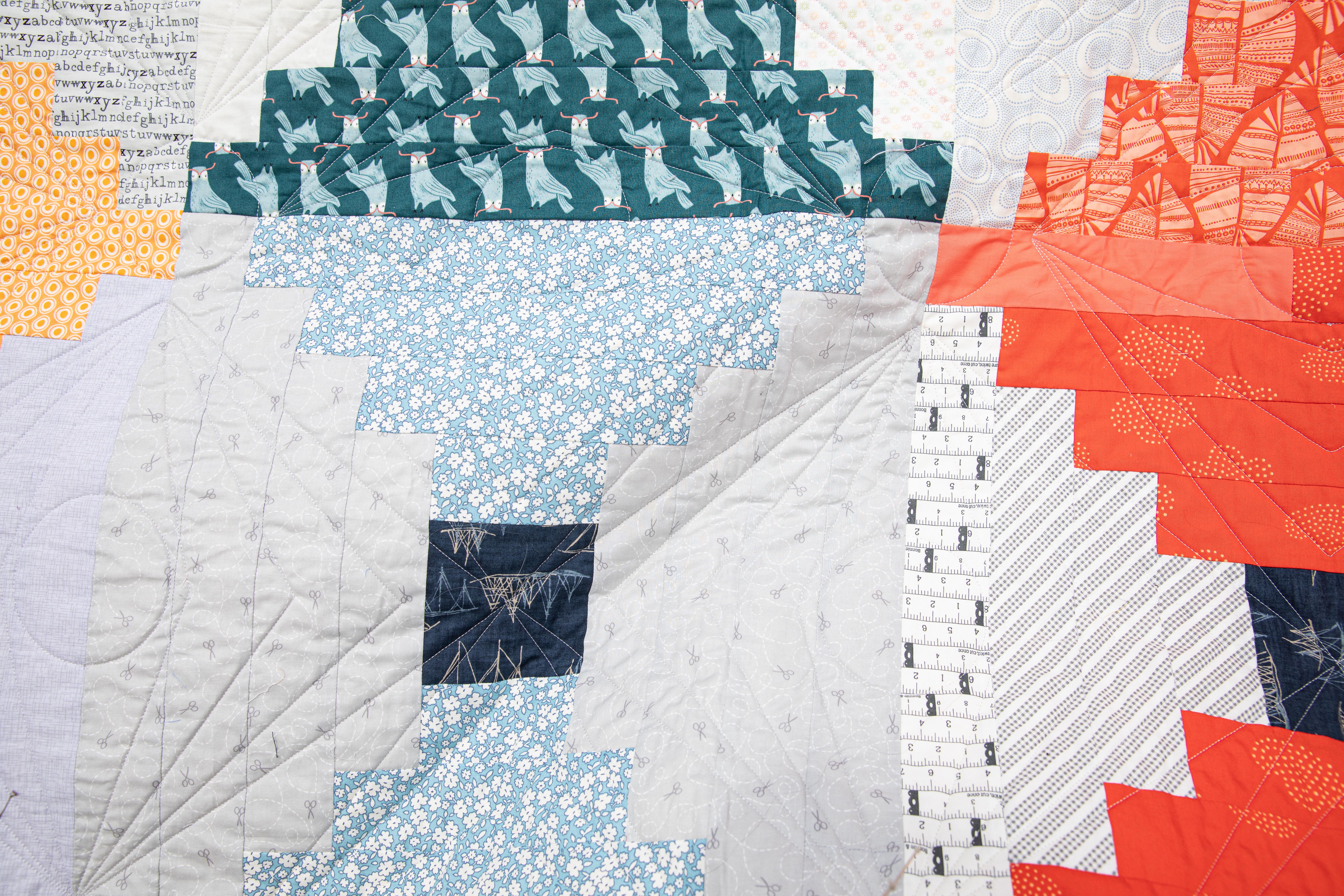
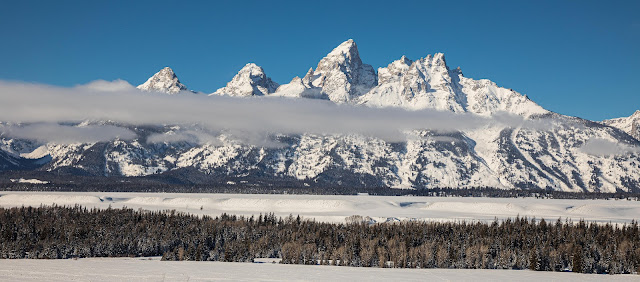
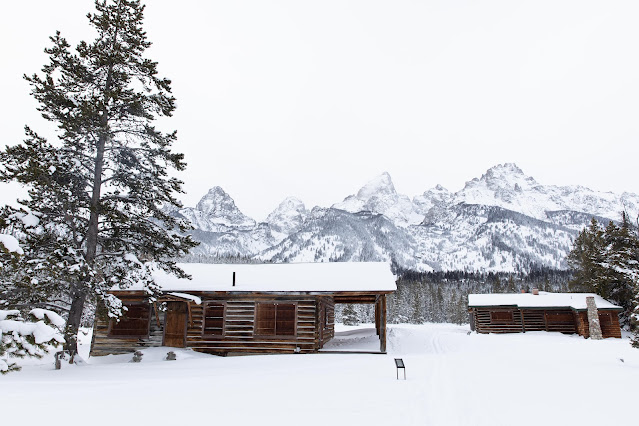
'"Once upon a time, sixty years ago, a little girl lived in the Big Woods of Wisconsin, in a little gray house made of logs." With these words Laura Ingalls Wilder began her beloved Little House series of books in which she recounted her early years and her family's search for a home in the mid-west. Wilder's descriptions of her log cabin homes helped shape my images of them as small but sturdy buildings offering shelter, warmth and security in as yet untamed places.
Some of these structures remain scattered across the United States, some in sad disrepair, others lovingly maintained as reminders of the pioneering spirit of their residents. In Jackson Hole, Wyoming, one of the iconic spots for photographers is Mormon Row, where the cabins and barns seem to be perfectly situated, their roof lines echoing silhouettes of the mountains behind them.
 |
| Sunrise at the T. A. Moulton Barn |
 |
| The John Moulton Barn and the Grand Teton |
More incongruous is the cabin in the middle of downtown Dallas. This one, dating from about 1850, was moved to its current site in 1971 to show where a cabin stood in the 1840s.
Some log buildings are still in use, such as the 1927
Adirondack Loj (pronounced "lodge"), which provides meals and overnight accommodation to Adirondack Park visitors.
During our early summer wanderings in the Adirondacks we spent a comfortable and quiet night at the lodge.
 |
| Adirondak Loj main room |
We chose a bunk room over a conventional private bedroom.
 |
| Adirondak Loj bunk room |
It is no surprise that log cabins have inspired generations of quilt makers. In many ways log cabin quilts are very like the structures after which they are named: simple, sturdy and warm.
Log cabin quilts are made of log cabin blocks. Each block starts with a center square, (representing the hearth, the literal and figurative center of a home), and then is built up, log by log, with each log oriented ninety degrees relative to its neighbors. Usually the logs alternate between two light and two dark, as though two sides of the cabin are in sun and two in shadow.
Here is a circa 1900 log cabin quilt that I purchased years ago at the City of Austin Garage Sale. The seller credited its making to an Annie Rocher, of Austin, Texas. That is unfortunately all I know of the quilt's provenance other than what can be gleaned from the quilt itself. The block arrangement is known as a "barn raising" set, and though not finely made, it has been well cared for. Many of the fabrics remain bright since it has seen little use as a bedcover and has apparently never been laundered. I think the exuberant use of red makes for a lively composition.
 |
| Annie Rocher log cabin quilt (note it is 11 blocks wide and 10 blocks high) |
Annie Rocher used a large collection of fabrics including solids, prints and plaids in cotton, silk and blends, so many that it seems that every time I look at it I discover another fabric I had not previously noticed.
 |
| Detail of Annie Rocher quilt |
Here is my own recent version of a log cabin quilt. I made it as a birthday gift for a dear friend and hope that, unlike Annie Rocher's quilt, it will be used until it is in tatters.
The color scheme, which is rather on the cool side and a little unusual for a log cabin quilt, came to life in the class I took with Weeks Ringle and Bill Kerr at QuiltCon earlier this year. When I mentioned that I was planning a log cabin quilt Weeks and Bill quickly picked out from my stash a bunch of taupes and neutrals, some old shirtings and a few plaids, and suggested rich brown, one of their go-to colors, for the block centers.
I don't know if this is what they envisioned, but I really like the result. I think it is a subtle and fresh take on an old favorite. Viewed from a distance you can easily see the difference between the dark and light sides of each block, but up close you can't. When I was assembling it I had to keep stepping back to ensure each block was correctly oriented. In spite of its subdued colors, the zig zag pattern, fittingly called a "streak of lightening," gives the piece energy.
I made it without borders and used a black and grey stripe for the binding.
For those of you interested in the details of the quilt's construction, I pieced it by machine and quilted it, block by block, using the computer guided function of my long arm machine. I combined two corner patterns to make a square, changing the orientation of it for each block so that the dark half was quilted in the denser pattern and the light half in a more open pattern.