Quilt Gallery

Saturday, April 30, 2022

Tracking Mountain Gorillas in Bwindi Impenetrable Forest

Mountain gorillas are fascinating animals with complex social structures. They are rare, living exclusively in the mountainous volcanic rift area of central Africa spanning Democratic Republic of Congo, Rwanda, and Uganda. They are also endangered due to loss of habitat, poaching, disease and human conflict. It is believed that they currently number approximately 1,000 individuals, a significant increase since 1989 when only about 600 existed. 

I was thrilled to have the opportunity to see mountain gorillas in Bwindi Impenetrable Forest last year. Even better was that we had permits to visit them on three separate days. Bwindi Impenetrable National Park covers almost 128 square miles of heavily forested and steep terrain in the far southwest corner of Uganda. Though nearly at the equator, the nights are cool and the days moderate due to its high elevation, from about 1,100 meters up to 2,600 meters.

Each day we were assigned a different gorilla group to observe. Rangers who are thoroughly familiar with the gorilla groups, individual gorillas, and the Bwindi forest patiently led us to our assigned family. Here you see part of the Habinyanja group, including the alpha male.

The rangers were armed with rifles to scare off aggressive elephants (which thankfully we never encountered) and machetes to clear paths through the jungle.

These gorilla groups have been habituated to humans and while they don't entirely ignore people, they do carry on with their daily lives in our presence. We were allotted one hour to observe them each day. It seemed to me that they were aware of this time limit as they began to wonder off at the end of the hour.

Here is a sampling of images of the Habinyanja group. We saw them resting,


eating,


socializing,


and posing for photographs. Okay, maybe that's not what this silverback was doing, though it sure seemed that way.


Our second day demonstrated the appropriateness of the name Bwindi Impenetrable Forest. The rangers hacked away with their machetes to clear paths for us and it took real effort on our part to climb steep and slippery hillsides to reach the Rushegura group. 

We were rewarded with front row seats to watch this energetic 14 month old. 


He spent a lot of time clambering around on his ever patient mother. 


Gorillas spend most of their time on the forest floor,


but the younger and lighter ones especially do climb trees.


As one of humans' closest relatives, it is not surprising that mountain gorillas have expressive faces. They are absolutely fascinating to watch. Here the alpha male of the Rushegura group seemed to be pondering weighty matters. 


This approximately two month old infant from the Muyambi group was the youngest gorilla we saw. It was conceived and born during the Covid pandemic, so part of an apparent mountain gorilla baby boom that took place during the time that human visitors were mostly absent.   I think the tight grip this little one has on its  mother's face is adorable!


This gives you an idea of what the experience was like for us. We were required to wear masks when in the presence of gorillas and instructed to keep at least ten meters distant from them.  In some cases they approached us and then we just needed to remain still.


I traveled with Cheeseman's Ecology Safaris on this trip, and can highly recommend them. They have years of experience running excursions like this and it shows. My trip went smoothly from beginning to end, we had lots of time with the wildlife, benefitted from experienced and knowledgeable guides, and enjoyed a high standard of accommodation and excellent food.

I will try to write one more post highlighting the non-wildlife parts of my trip, including some of the remarkable people I met and the beautiful countryside that I was privileged to see

Tuesday, March 22, 2022

Queen Elizabeth National Park, Uganda

While my trip to Uganda focused on primates, especially chimpanzees and mountain gorillas, we also spent a couple of days in Queen Elizabeth National Park observing other iconic African wildlife. Our first stop was Lake Edward where we boarded a boat for a cruise along the wildlife-rich Kazinga Channel, which connects Lake Edward to Lake George. Of all the animals and birds we saw from the boat my favorites were the crocodiles


and the hippos lurking in the shallows. 


We also saw local fishermen repairing their nets on shore and fishing from small boats on the lake.

From Lake Edward we continued to Ishasha Wildeness Camp, along the Ntungwe River in the southern part of the park. As we neared camp at dusk, we were greeted by a trio of lions in and around an enormous fig tree. This one was draped across two branches, with his apparently full belly hanging in between.


Though we laughed at his comically distended belly, in profile he looked every inch the king.


He really was gorgeous! Getting photos of him was one of the highlights of the whole trip. Lions in this part of QENP are well known for their unusual behavior in climbing and resting in trees. Apparently they do so to avoid insects and heat on the ground and to get a better view of prey. 


We spotted a number of elephants during our visit, but this quartet, a big female with three youngsters obliging lined up in size order, was my favorite group.


The littlest one just had to break away from the rest to show off.


As is typical for game drives, we got an early start. Morning fog and mist lent an air of mystery to the park.


And then suddenly it was a brilliant day with hundreds of animals in sight. Here is a herd of kob, a subspecies of antelope, and several topi.


Here is a close-up of a male kob, displaying his exquisitely curved horns (and a cloud of insects buzzing around him). 


Water buffalo are also quite prolific in the park. They seemed to watch us with great curiosity.

If you're curious to see more Ugandan wildlife, check back soon for my post on the mountain gorillas of Bwindi Impenetrable Forest.

Friday, February 18, 2022

Winter Adventures in Grand Teton

Most visitors to Grand Teton National Park arrive in the summer and early fall when clear trails draw hikers into deep canyons, and up to colorful wildflower meadows and high passes for close-up views of  craggy peaks. Lakes beckon sweaty hikers to cool off in their sparkling waters. And there is always the possibility of encountering wildlife, from large animals such as bears and moose to adorable and charismatic pica and marmots.

Winter offers a completely different kind of magic: snow everywhere, sparkling fairy tale scenes, and an enveloping quiet.


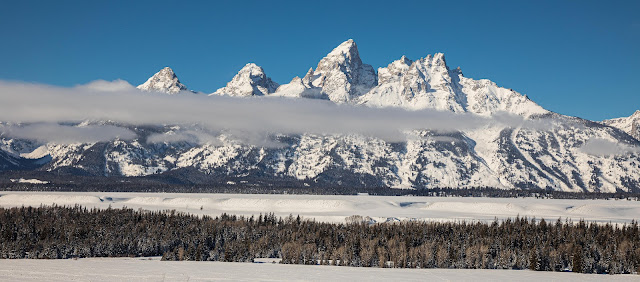
This year we appreciated winter in the Tetons more than ever by making cross country ski excursions throughout the park. Views of this iconic mountain range never get old!


At the northern end of the park Mount Moran dominates. 


If you are interested in your own trip, the park road from Taggart Lake Trailhead is a good starting point. Grand Teton National Park Foundation generously funds regular grooming of this road for classic and skate skiers all the way up to Signal Mountain. Here is a view from just north of the parking area.


More advanced skiers may want to venture beyond the groomed tracks. Make sure you are well prepared and good at route finding though!


Keep in mind that while bears are hibernating, you may still encounter other wildlife.


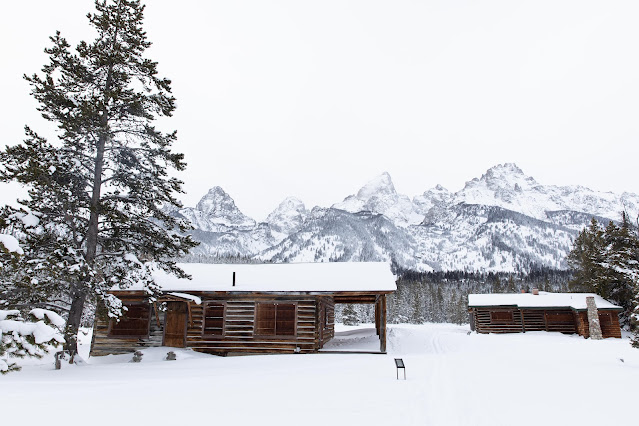
You might also come across old cabins, most of which pre-date establishment of the park. As far as I know, they are all closed in the winter, and like wildlife, they should be respected and left undisturbed.


My fascination with log cabins clearly extends to quilting. Log cabin quilts are among my favorites and my most recent quilt top finish is a log cabin.


Making it out of what happened to be available - in this case lots of scraps - seems very appropriate since real log cabins were made the same way - using the wood that was available nearby. In this case the scraps came from other quilts I've made over the years and from bits and pieces in a seemingly bottomless box of vintage fabrics that I acquired years ago at the Austin Area Quilt Guild Show. 

I started out randomly picking fabrics for each block but eventually switched to working with one color family per block so it ended up being a crazy mash up of color. At least the pattern is clear due to consistency in color values. The idea for the peaks and valleys border came from Rachel Hauser at Stitched in Color.


It was very satisfying to use up so many disparate scraps. Now to get it quilted.


Monday, January 31, 2022

Chimpanzees in Uganda's Kibale National Park

I have been thinking how lucky I was to make a trip to Uganda last fall, and now that we are in the midst of additional restrictions and consequences due to the Omicron variant of Covid, I am even more appreciative! I was one of seven people, including our guide, to make the trip, which packed into twelve days visits to Kibale, Queen Elizabeth and Bwindi Impenetrable Forest National Parks. I'll cover Kibale National Park and its chimpanzees in this post, and follow up with additional posts on the other parks.

We spent three days in Kibale with the chimpanzees. I should note that these were all habituated chimpanzees, meaning that the group and individuals have become accustomed to the presence of humans. Information on habituation is available through the Jane Goodall Center

After a short introduction to the park by the rangers we were each assigned a porter to carry our camera gear. The latter is optional, but highly recommend as it made our day easier and pleasanter and contributed to the local economy. Generally several rangers scout chimpanzee locations ahead of time so visitors don't have to spend a lot of time tramping around in the rain forest in search of them. Still, we walked from one to three miles each day to reach the group we would be observing, and then since chimpanzees often travel throughout the day we walked several more miles observing them. We had three hours with our assigned family each day, starting from the time we first came within sight of them, so we saw all kinds of behaviors.

In the mornings the chimpanzees were up in the trees, having spent the previous night in a tree nest made for sleeping.


Eventually they clambered down to the forest floor where they spent a good part of the day. 


Sometimes they would lay down to rest, looking up at the tree canopy and sky. 


They looked so contemplative that I wondered what they were thinking about. 

At other times they sat, often using a log as a seat. They seem to like holding on to sticks. Maybe that's some kind of evolutionary hint that people like me would come to like to playing with knitting needles!


Other activities were eating, 

grooming,

and traveling.

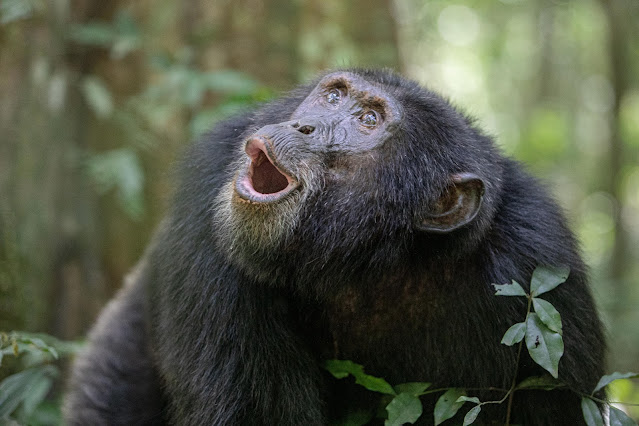
We heard and saw all kinds of communications, including pant-hoots, 


drumming on trees, which makes an incredibly loud, percussive sound, screeching, and running around waving large sticks. We were allowed to record their sounds, but not allowed to replay them while in the forest to avoid sending confusing signals to the chimpanzees.

Relationships among chimpanzees are fascinating to watch. As with most species, mother-infant bonding is strong and the expressive faces of youngsters make them particularly heart-warming to observe. Here is a darling face to love!


Traveling with Covid still prevalent around the world required planning and patience, but it was well worth it.  Every member of our group was fully vaccinated against Covid, a requirement of the tour company, Cheeseman's Ecology Safaris, and we all had PCR tests prior to departing the United States, and another one prior to departing Uganda for our journeys home. There were health forms to fill out when changing planes, documentation of having had a Yellow Fever inoculation, plus temperature checks at airports. And, of course, the ubiquitous wearing of masks. Although the overall Covid vaccination rate in Uganda was still in the single digits during my visit, the country had prioritized vaccinating workers in the tourism industry, a reflection of how critical tourism is to their overall economy. It seemed that just about every person we came in contact with had been vaccinated. Park staff were also careful to remind us to wear masks when we were in the presence of the chimps or gorillas. As extremely close genetic relatives of ours, we are all susceptible to the same infections, so masks protect the animals and ourselves.

If you are interested in this trip, you can find details of Cheeseman's fall 2022 trip here.


Monday, April 19, 2021

Three Little Quilts

Over the course of the last year I pieced a dozen quilt tops, but never quilted any of them because Covid temporarily closed the studio I where I was planning to rent time on a long arm machine, and then I got in the habit of staying home and didn't re-book time to quilt. Now that establishments are opening up and I have one vaccine in my arm I am venturing out more and finally made it into the studio. 

I spent a long afternoon at Over the Top Quilting Studio in Cedar Park, Texas, and got three small tops quilted. (Photographing your children in the bluebonnets is a springtime ritual in Texas, so naturally I photographed a couple of these babies in the bluebonnets.) The idea for this first one, a cross quilt, came from the Dallas Modern Quilt Guild and was a great way to use up a bunch of larger scraps and some not so favorite fabrics.


I've previously shared a photo of this one, called "Blues Around the World," when it was just a finished top. I hand pieced it, using up a lot of scraps, during various travels before the world shut down due to the pandemic.


I think this cheater panel from Denyse Schmidt makes a really fun back for it.


Speaking of Denyse Schmidt, this next top is from the Free-Wheeling Single Girl quilt along she led last year. It's a little wonky because I sketched my own paper templates and pieced the circles by hand without being terribly fussy about accuracy. I've finally made myself honest by buying a set of the acrylic templates -- Denyse deserves to be paid for her creative work. I know I should have made more of an effort to pay sooner, but better late than never.  

As for the quilting, I used APQS's QuiltPath on a Millie long arm machine to quickly and accurately quilt closely spaced straight lines. Just set it up and let it go.


Now that I've got these three completely finished, it's time to reserve another block of time at the quilt studio. I should note that I felt completely safe spending hours at Over the Top Quilting Studio because they follow strict health safety guidelines to protect themselves and their customers. It doesn't detract at all from the fun of quilting with like-minded crafters.